In Tokyo’s Sekiguchi district, St. Mary’s Cathedral rises from the city as a series of stainless-steel-clad concrete wings. Designed by Kenzo Tange and completed in 1964, the building is one of the most striking examples of postwar Japanese modernism: a cathedral that feels less like a traditional church and more like a burst of light caught in structure.
Its form is memorable in photographs, but the building’s real power lies in the way it organizes movement, light, and worship. Tange used a simple cruciform plan, then transformed it through a daring folded roof. The result connects the symbolic language of a cathedral with the technical confidence of a rapidly changing Japan.
A new cathedral for a new era
The earlier cathedral on the site was destroyed during the Second World War. When the Tokyo Archdiocese commissioned a replacement, the task was both practical and symbolic: create a place for worship that could look forward without losing the spiritual weight of the institution it served.
Kenzo Tange was already emerging as one of Japan’s most important architects. His work often combined modern construction with an interest in the spatial clarity of traditional Japanese buildings. At St. Mary’s, he avoided copying historical European church forms. Instead, he asked what a cathedral could become when expressed through concrete, steel, and the energy of postwar Tokyo.
The geometry of a cross
From above, the plan is organized around a cross. Eight sweeping concrete walls rise and meet toward the center, creating a tall, luminous interior. The gaps between those folded surfaces are finished in metal and glass, so daylight enters as sharp vertical seams. The architecture does not rely on painted ornament to create drama; the drama comes from the structure itself.
This is a key part of Tange’s achievement. The building is both abstract and deeply legible. Even a first-time visitor can sense the upward movement of the walls and the pull toward the central altar. The form gives a physical expression to ideas of gathering, ascent, and light.
Concrete that feels weightless
Concrete is often associated with mass and permanence. At St. Mary’s Cathedral, Tange uses it to create something unexpectedly light. The folded walls carry the building upward, while the narrow glazed seams separate the planes visually. In changing daylight, the interior can feel almost detached from its own structure.
That contrast is why the cathedral remains important to architects and students of design. It demonstrates that material does not have a fixed emotional meaning. Concrete can be heavy, protective, rough, calm, or soaring, depending on proportion, light, and the way surfaces meet.
Kenzo Tange and Japanese modernism
Tange’s career helped establish Japan as a major voice in modern architecture after the war. He is known for projects that brought together civic ambition, engineering, and cultural memory, including the Hiroshima Peace Memorial Museum and the Yoyogi National Gymnasium. St. Mary’s Cathedral belongs to this broader body of work, but it has a distinctive intimacy: it is a public landmark built around private reflection.
The building also influenced later generations of Japanese architects by showing that modernism could be expressive without becoming arbitrary. Its strong geometry is not a decorative gesture. Every fold contributes to the building’s plan, structure, and experience of light.
Why the cathedral still resonates
Many twentieth-century churches attempted to modernize sacred architecture through new materials. St. Mary’s Cathedral remains exceptional because its innovation is inseparable from atmosphere. The exterior has the clarity of a sculptural object, while the interior is shaped by changing light and a strong sense of vertical space.
For visitors, it offers a pause from the density of Tokyo. For architects, it remains a study in how a complex structural idea can become emotionally direct. The cathedral does not need elaborate explanation to make an impression; its form makes the argument immediately visible.
From Tokyo landmark to collected object
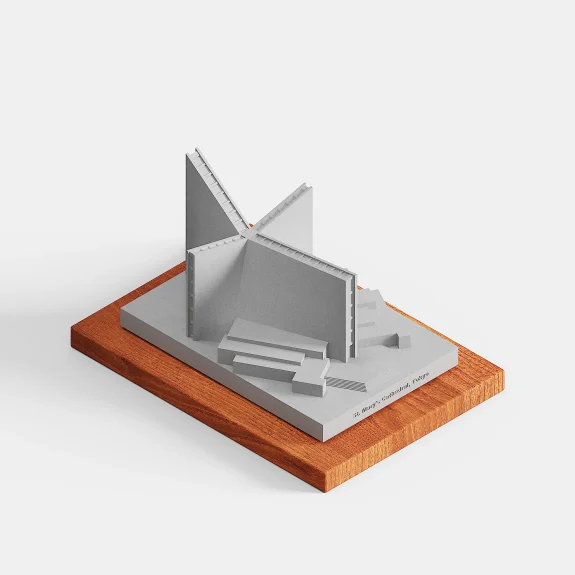
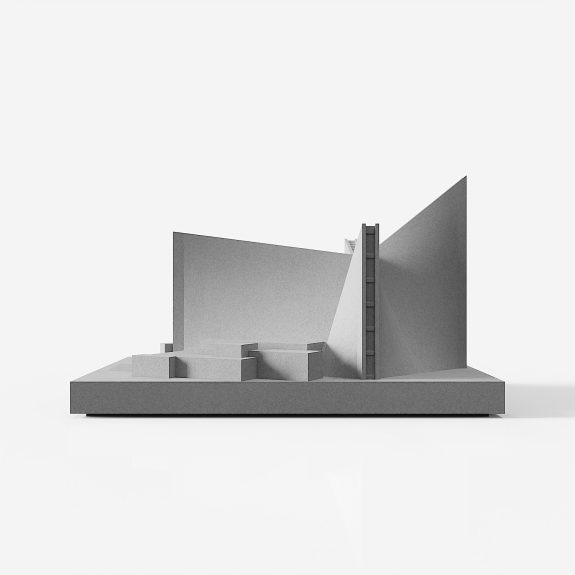
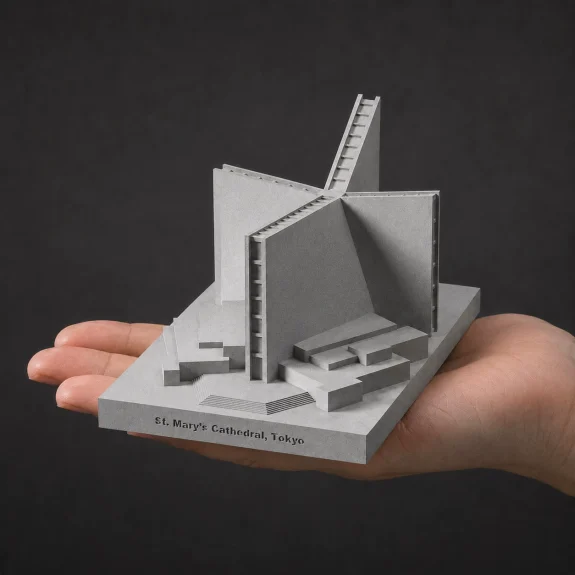
A small architectural model allows the building’s composition to be read from a new angle. The folded planes become a tactile study of geometry, shadow, and balance. Viewed on a desk or shelf, the cathedral’s silhouette still carries the sense of uplift that makes the full-scale building so memorable.
Our St. Mary’s Cathedral Concrete Architectural Model is hand-cast in fine concrete for collectors who appreciate Kenzo Tange, Japanese modernism, and sculptural architecture. Natural pores and subtle tonal variation are part of the material, giving each piece an individual surface character.
For architecture lovers and thoughtful interiors
This is an object for people who enjoy buildings not only as images, but as ideas made physical. It works naturally beside books on Japanese architecture, on a studio shelf, or as a gift for someone drawn to sacred space and modern design.
St. Mary’s Cathedral shows how a clear architectural concept can carry history, technology, and emotion at once. More than sixty years after its completion, its folded concrete form still feels like a vision of the future.
Explore more handcrafted concrete architectural models inspired by landmark buildings.