On Fifth Avenue in New York, the Solomon R. Guggenheim Museum refuses to behave like an ordinary museum. Instead of a sequence of rectangular rooms, Frank Lloyd Wright created a pale spiral that appears to unwind toward Central Park. It is at once a building, a route, and an argument about how art should be encountered.
For architecture lovers, the Guggenheim is not simply a famous landmark. It is a reminder that a public building can change the way people move, look, and remember. Its form has become so familiar that it is easy to forget how strange it was when it opened in 1959.
A museum designed as a journey
Wright received the commission in 1943 from Hilla Rebay, the museum’s first director. She wanted a home for non-objective art that would feel different from the established institutions of Manhattan. Wright responded with a design whose central idea was movement: visitors would take a lift to the top and descend slowly along a continuous ramp, encountering art as part of one unbroken promenade.
The concept was radical because it replaced the neutral gallery with an architectural experience. The floor slopes gently, the walls curve, and the large glass dome gathers daylight at the center. Whether one agrees with every practical decision is almost beside the point. The Guggenheim makes the visitor conscious of the body in space.
Why the spiral mattered
Most museums are organized as collections of rooms. Wright designed the Guggenheim as a single interior landscape. The spiral gives visitors a clear orientation while constantly changing their view across the atrium. Art is never encountered in isolation; it is framed by the ramp, the skylight, other visitors, and the city beyond.
That unity is what gives the museum its cultural force. The building became an icon of American modernism not because it was simple to categorize, but because it made a strong formal idea visible at the scale of the city. Its white concrete shell still feels more like a sculptural object than a conventional facade.
Architecture, concrete, and light
Concrete allowed Wright to make the continuous curves that define the building. Yet the museum does not feel heavy. The layered ramps, horizontal bands, and broad skylight create a sense of lift, as if the structure were caught in motion. This tension between mass and movement is one reason the Guggenheim remains compelling in photographs, drawings, and models.
Its influence reaches far beyond museum design. Architects continue to return to the building when thinking about circulation, public space, and the possibility that a cultural institution can have a memorable identity without copying historical styles.
Looking beyond the familiar image
The Guggenheim is often reduced to a photograph of its exterior, but Wright conceived it as a complete sequence. The low entrance canopy compresses the arrival, the atrium opens suddenly upward, and the ramp creates a measured pace rather than a series of quick stops. Even the continuous guardrail and the horizontal bands of the facade reinforce the sense that the building is moving.
That sequence helps explain why the museum remains useful to study. It asks a practical question with unusual conviction: can circulation be the main architectural idea? Wright’s answer makes every visitor a participant in the composition. The route is not a neutral corridor between artworks; it is the experience that holds the museum together.
A different kind of modern monument
When the museum opened, many New Yorkers found it controversial. Its curves stood apart from the rigid street wall of Fifth Avenue and from the box-like office towers associated with mid-century Manhattan. Over time, that difference became its strength. The Guggenheim showed that a cultural building could be immediately recognizable without relying on historic ornament.
Today it continues to offer a useful lesson for designers and collectors: memorable form works best when it grows from a clear spatial idea. The spiral is not an applied symbol. It is the museum’s way of organizing people, light, structure, and attention.
From landmark to tabletop object
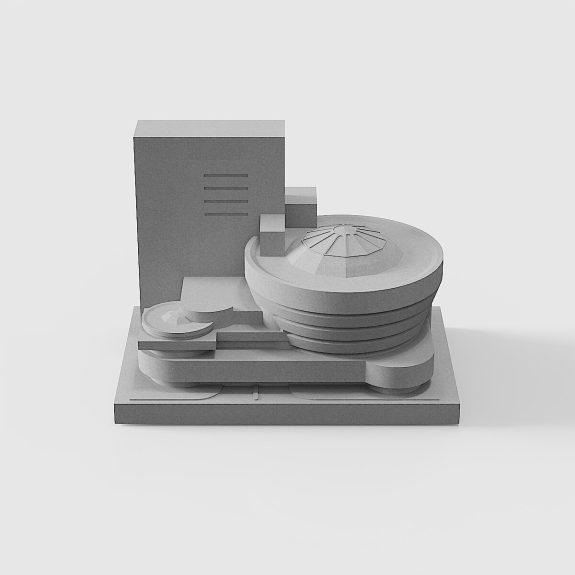
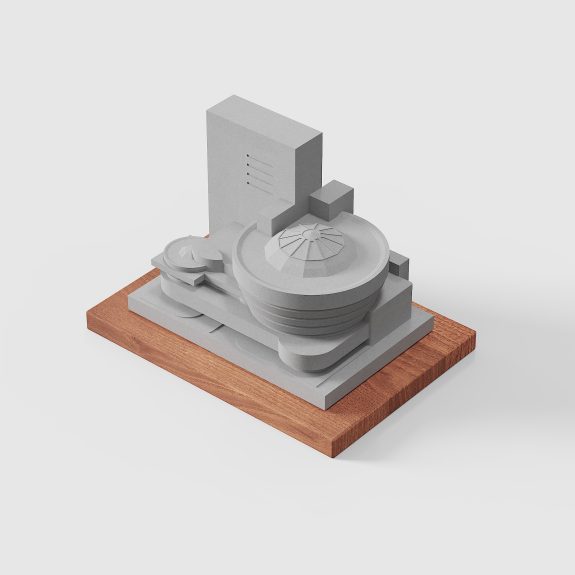
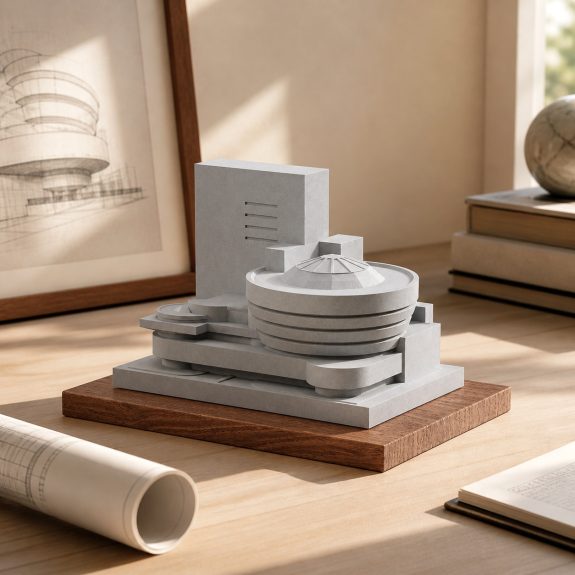
A small model makes it possible to read the Guggenheim differently. Without Manhattan around it, the spiral becomes a pure study of proportion, shadow, and continuous form. The eye travels around the model much as a visitor travels through the building: always following the curve, always finding another relationship between wall, ramp, and void.
Our Guggenheim Museum Concrete Architectural Model is hand-cast in fine concrete and designed as a tactile architectural object for a desk, shelf, or library. Its natural pores and tonal variation are part of the material’s character, so every cast carries a slightly individual surface.
Why it still belongs in the conversation
More than six decades after opening, the Guggenheim still provokes discussion about whether architecture should remain in the background or take an active role in the experience of art. Wright’s answer was unmistakable: the building itself can be a work of culture, capable of directing attention and creating memory.
For collectors, students, and design enthusiasts, the museum remains a compact lesson in how one clear idea can reshape an entire typology. Its spiral is not decoration. It is the building’s structure, circulation, identity, and story made visible.
Explore more handcrafted concrete architectural models inspired by landmark buildings.