On a hill in eastern France, Notre Dame du Haut at Ronchamp appears less like a conventional church than a vessel shaped by wind, weather, and light. Designed by Le Corbusier and completed in 1955, the chapel changed expectations of what modern architecture could be. It is heavy, irregular, and deeply expressive – qualities that were surprising after the disciplined grids of earlier modernism.
Ronchamp matters because it proved that concrete architecture could be spiritual without imitating historical churches. It invites visitors to slow down, move around its thick walls, and notice how light turns into a material of its own.
A commission after destruction
The site had long been a place of pilgrimage, but the previous chapel was destroyed during the Second World War. The new commission carried an emotional weight: it had to serve worshippers while responding to a landscape marked by loss and renewal. Le Corbusier approached the project not as a standard church plan, but as an opportunity to make a place of encounter between sky, ground, and human ritual.
The building’s white walls curve and thicken; the roof rises like a dark floating shell. Small openings cut through the walls at different angles, each one catching daylight differently. Nothing is repetitive in the ordinary sense, but the composition feels carefully balanced.
Light as a building material
The most memorable feature of Ronchamp is its light. Rather than filling the interior with large glazed openings, Le Corbusier punctured the thick walls with deep, irregular apertures. Sunlight enters as separate beams, colored glows, and changing patches across the surface. The effect is intimate rather than monumental.
This approach gives the chapel a very different character from the glass-and-steel modernism of the same period. Concrete is not used merely as structure. Its thickness creates depth, shadow, and a sense of protection. The material makes light more precious because it is carefully framed.
A turning point in modern architecture
Ronchamp is often discussed as a break from the machine-like image associated with early modernism. The chapel is still modern in its construction and refusal of historical imitation, but it accepts irregularity, memory, and emotion. It helped open a path for later architects who wanted modern buildings to feel tactile and humane.
Its influence can be felt in contemporary museums, chapels, and houses that use mass, texture, and controlled openings to create atmosphere. The lesson is not to copy the roof or the windows. It is to understand that form can communicate feeling when it is tied to place and purpose.
Moving around the chapel
Ronchamp reveals itself gradually. From a distance, the roofline appears almost detached from the walls; closer up, the thickness of the concrete and the depth of the openings become apparent. Each side of the chapel has its own character. One wall is more solid and protective, another opens toward the landscape, and the outdoor altar allows large gatherings to take place on the hill.
Le Corbusier treated the approach as part of the architecture. The changing ground level, the uneven silhouette, and the shifting light make the building feel discovered rather than simply viewed. This is why Ronchamp is so difficult to understand from a single photograph. It has to be mentally walked around.
Material with an emotional charge
The chapel’s rough concrete and whitewashed surfaces carry traces of making. They are not polished into anonymity. That texture gives the building a human scale and connects it to the agricultural landscape around it. The roof seems to hover, yet the walls feel protective and ancient at the same time.
For contemporary designers, Ronchamp remains a reminder that material can do more than signal efficiency. Concrete can frame silence, amplify light, and hold memory. The building’s power comes from the combination of those effects, not from any single dramatic gesture.
Reading Ronchamp through a model
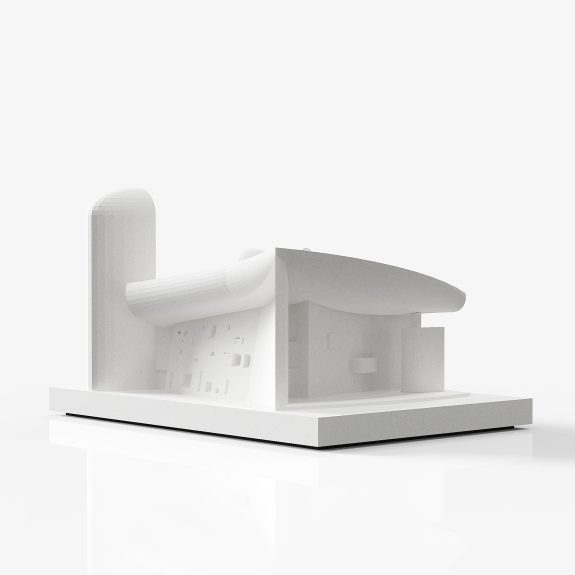
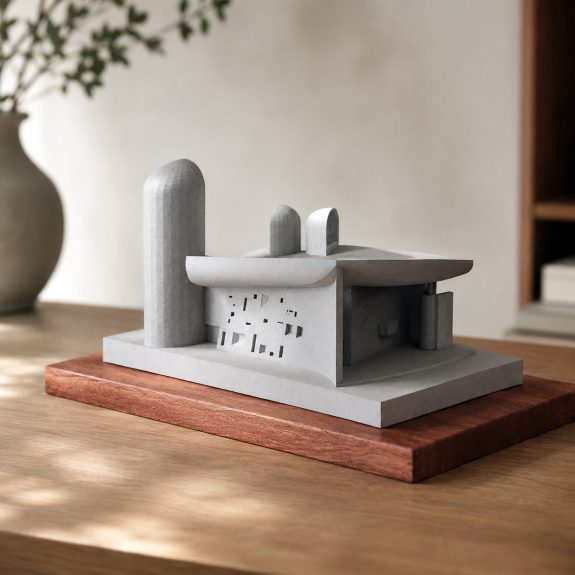
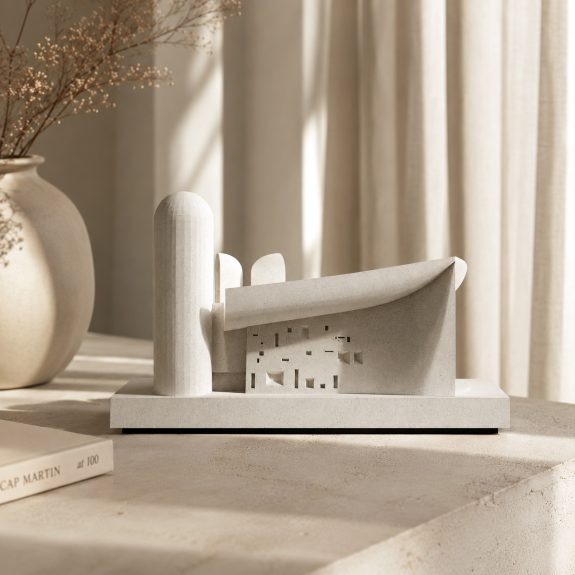
At a small scale, Ronchamp becomes a study in silhouette. The roof, walls, and openings can be viewed from all sides, revealing why the chapel has remained so compelling in photographs and architectural drawings. A model also makes the building’s asymmetry easier to appreciate: every elevation has a different relationship to the hill and to the sky.
Our Ronchamp Chapel Concrete Architectural Model is hand-cast in fine concrete to emphasize that sculptural mass. It is made for people who want an architectural object with cultural depth, whether placed among books, on a studio shelf, or as part of a collection of modernist icons.
Why Ronchamp endures
Many famous buildings are remembered for a technical innovation or a striking facade. Ronchamp endures because the whole experience holds together: approach, horizon, material, sound, shadow, and quiet. It suggests that architecture can be modern without being cold, and expressive without becoming arbitrary.
For anyone interested in Le Corbusier, sacred architecture, or the emotional possibilities of concrete, Ronchamp remains one of the essential buildings of the twentieth century.
Explore more handcrafted concrete architectural models inspired by landmark buildings.